By Elle Logue,
Editor-in-Chief.
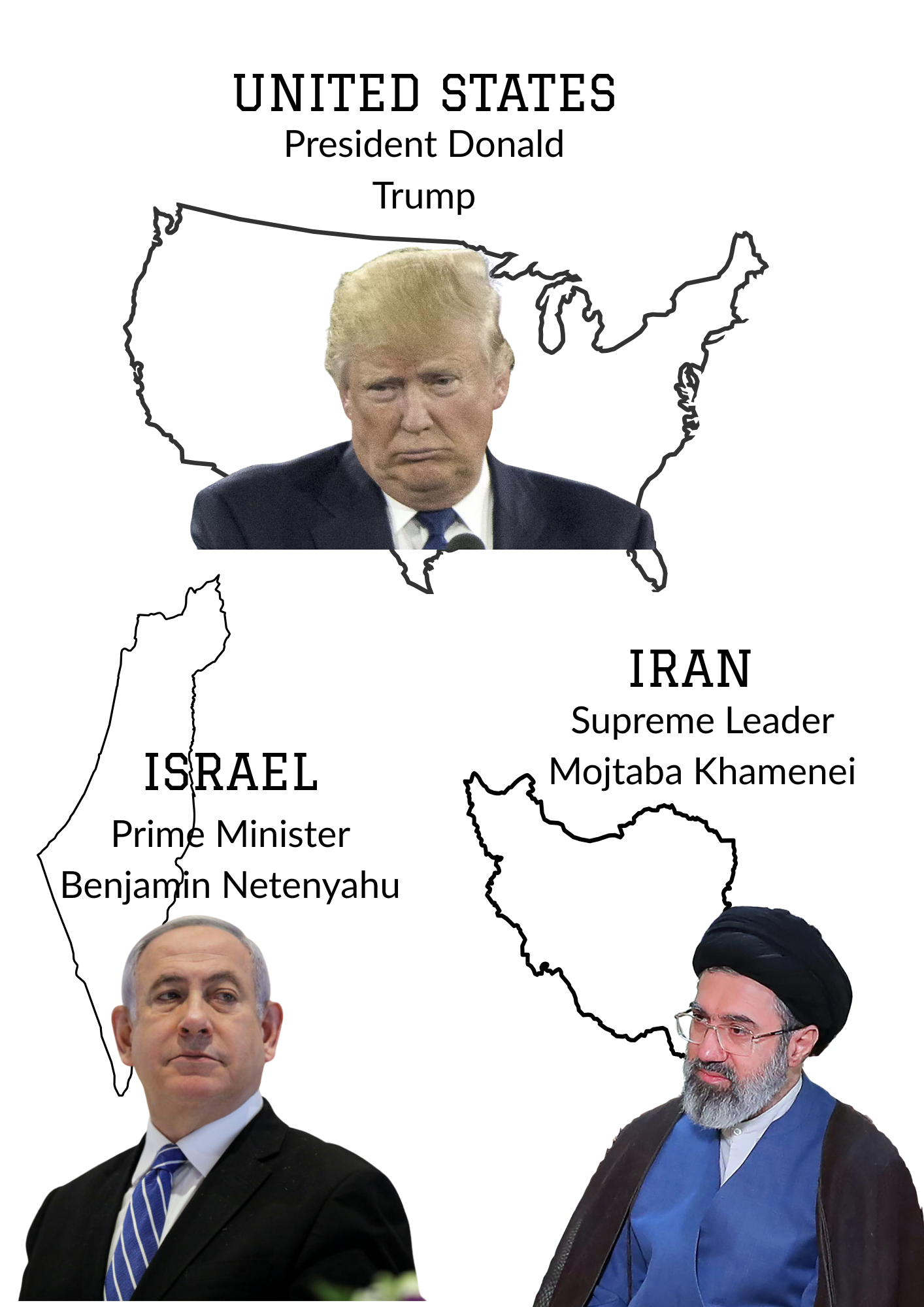
In a joint attack on Feb. 28, 2026, the United States in conjunction with Israel launched strikes on Iran, targeting Iranian military bases, nuclear facilities and leadership.
The attacks killed Supreme Leader Ayatollah Ali Khamenei of Iran, who was succeeded by his son, Mojtaba Khamenei. Iran immediately began counterstrikes, targeting the Gulf States and U.S. military facilities. Tentative truces and ceasefires have been agreed upon. The U.S. and Iran are simultaneously blockading the Strait of Hormuz. The White House has requested $1.5 trillion from Congress for the war, but Congress has yet to make a decision on the budget. With the ceasefires expiring quickly, they do little to ease concerns over where this war may be going.
Government teacher Andy Brennan refers to the war with Iran as opening “Pandora’s Box,” essentially forcing the U.S. to pursue one of two actions: “militarily defeat the Islamic Theocracy and replace it with a new government” or “agree to Iran’s demands to control the Strait of Hormuz and the pursuit of nuclear weapons and walk away.”
The attacks on Iran aren’t a sudden development, either, as the U.S. has been grappling with the best course of action for years. In June 2025, Israel bombed Iran’s nuclear facilities, sparking the Twelve Day War, which the U.S. got involved in. A ceasefire “ended” the conflict. Another link in this chain of events was the ending of the Iran nuclear deal, formally known as the JCPOA, which was put into place during the Obama administration, and was designed to monitor and control their nuclear facilities. The U.S. withdrew from the deal seven years ago under President Trump, but it officially ended in Oct. 2025. The current war’s aim is to incite a regime change in Iran, dismantle terrorist networks and completely wipe out the nation’s nuclear facilities.
Successful intervention in Middle Eastern affairs has long eluded the United States. The history of U.S. involvement in Iran goes back many decades. 73 years ago, in 1953, an Anglo-American coup known as Operation Ajax overthrew the democratically elected Prime Minister Mohammad Mossadegh. The coup was seen as an act of colonialism, with the goal being to protect oil-related economic interests, prevent communist overthrow in Iran and place a pro-West Shah in power. The Iranian Revolution later overthrew the Shah, replacing him with Ayatollah Ruhollah Khomeini.
We can point fingers all we want at the U.S. for the conflict in the Middle East, but it’s important to consider the whole story; the war with Iran is not driven solely by U.S. interventionist foreign policy, as many may conclude. Brennan said, “This is a very simplistic view. . . and absolves the internal players of the Middle East of any agency.” Iran is actually one of the few countries in the region where the general population favors the U.S., while the government does not. That key fact is the reason the U.S. is trying to destabilize the Iranian government, in hopes that it could be toppled internally and replaced with a new government. Iran is unique in comparison to other Middle Eastern countries in that “the Iranian people are the most likely to want a secular government,” explained Brennan.
Still, these hopes are far from becoming reality and the future of Iran remains to be seen. The wars that the U.S. has fought in the Middle East have lasted between one and 20 years. President Trump sends mixed messages, initiating peace talks, creating a stalemate at the Strait of Hormuz, preparing for a ground war, posting threats of war crimes on social media. Our nation appears to stand alone in this war, repudiated by both the U.N. and Pope Leo XIV, meaning the U.S. is lacking in support but also has no system keeping it in check. It’s hard to say what direction the war with Iran is going. It’s hard to say what winning this war even looks like.