By Starly Richards,
Media Editor.
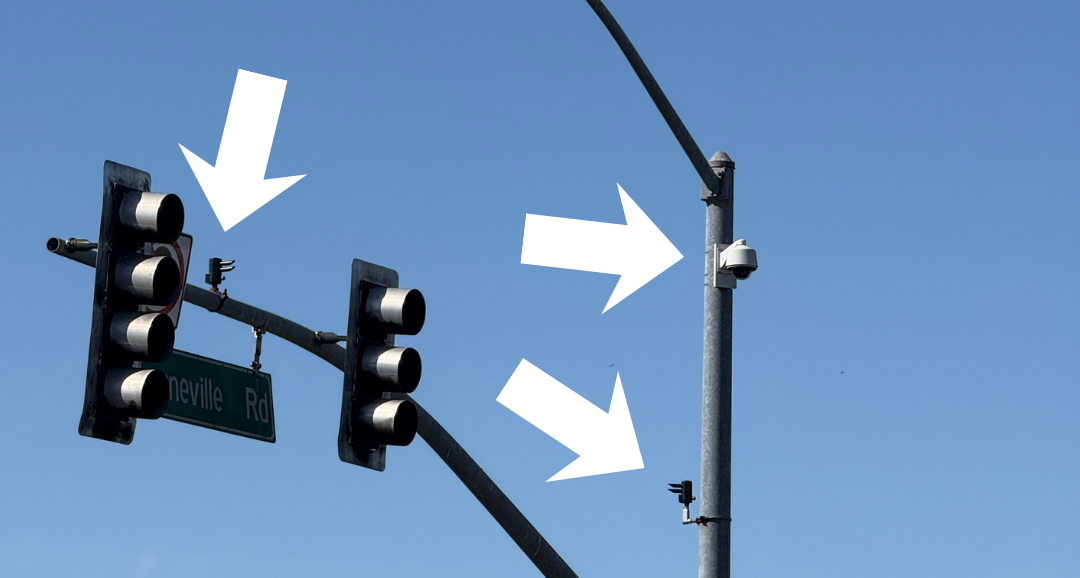
Have you felt like you are being watched as of recent? That might be because you are! Santa Rosa has installed hundreds of Automated License Plate Reader, or ALPR. These are high-speed, AI-powered cameras that capture the license plate numbers of passing vehicles. Unlike red light cameras, ALPRs are only meant to capture license plate numbers, not the person driving or any passerbys.
Once these numbers are captured, they are uploaded to government databases where they can then be tracked through a network of ALPR photo captures. The intended purpose of these cameras is to automate the tracking of any and all vehicles, wherever and whenever they may be driving past. These cameras are praised mostly for their usefulness in situations such as auto theft or outstanding warrants, where the license plate of the vehicle is known but not the location of the offender.
Autoshop teacher Mitchell Ustey said, “Rather than helping us, it is causing innocent people to be fined, and sometimes jailed, for things that the tech, or the person reading the tech, misread or misunderstood.” Since the knowledge of the technology has become widespread, it has not been well-received.
Even though the technology has become a focal point of political discussion in recent months, the technology actually traces back to the 1970s. “In the 1990s we got cameras at pretty much every stoplight, we got tracking on all cellular towers that makes it not only possible, but easy to aggregate data and track individuals just by them having their cell phones on them,” said Utsey. “That was in the early days of all this, and it hadn’t gotten to the point that each and every one of us was being tracked.”
The increasing levels of surveillance and media censorship have reminded people of the novel 1984. Utsey said, “People got used to the government looking out for them, not paying attention to how much tighter everything had become, how the agencies who are supposed to be watching out for us are now just watching us.” One company in particular has made a name for itself in the world of ALPRs: Flock Safety. Many people know ALPRs only as “Flock Cameras” due to the nationwide use of this company’s technology. “Flock, and the other companies, are just the tip of the iceberg, the visible part of the problem,” said Ustey. The distribution and use of these cameras not only resembles popular examples of mass surveillance, but has also allowed for hundreds of instances of misuse by officers of the law and government officials.
The special thing about Flock Safety ALPRs is that not only do they capture license plate details, but also the make and model of the car and any scratches, dents or stickers that make it unique. “My first posting in the army was in military intelligence. I can tell you the soviet union would have loved to have access to this stuff,” warned Utsey. This information is available to law enforcement and does not require a warrant, resulting in abuses such as being frequently used to track immigrants and people who have crossed state lines to access services unavailable in their own state without any court orders to do so. There are roughly 170 reported cases of law enforcers using the technology to stalk women they are interested in or that they have history with.
Ustey shared, “The data from those cameras is being shared, sold, misused by going to companies and individuals who have no legal right to it, but have the money to get it and then use it for their own purposes.” The proof is in the pudding; our government is showing less concern about the safety of the American people and more about the control that they have over us.
If you are concerned about Flock Cameras stalking your daily route, or if you have any other reason you would need to locate them, many websites have been created for the sole purpose of identifying them. One of the most popular is deflock.org, founded by software engineer Will Freeman in October 2024, which displays not only the location of the cameras, but the direction they are facing as well. We already live in a world where everything is broadcasted, and personal info is available to the masses via social media; we don’t need to lose more privacy than that.