By Henry Parkinson,
Staff Writer.
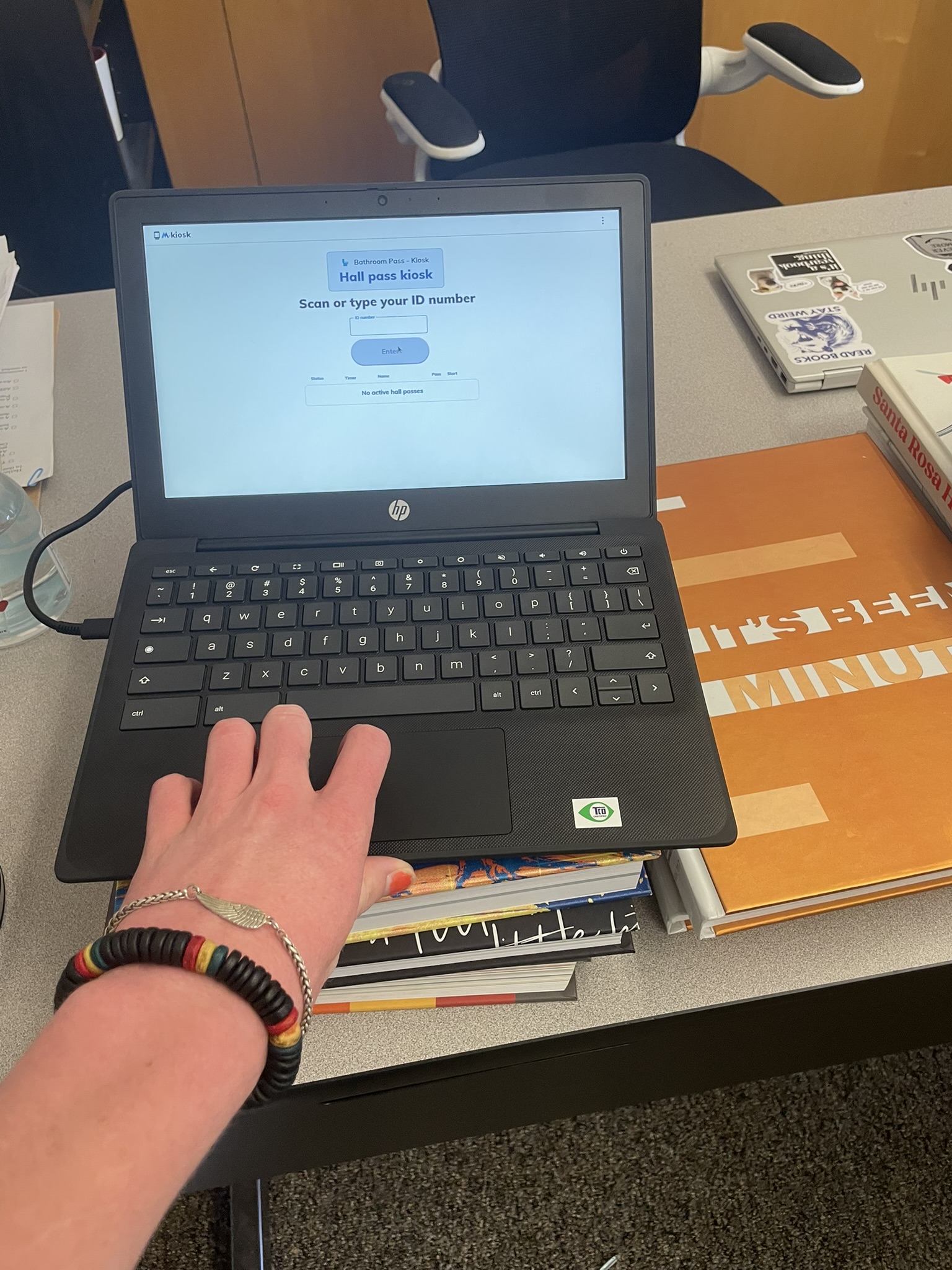
The 2026-2027 school year at SRHS has been one fraught with policy changes, many of which are unpopular amongst the student body. One controversial change has been the replacement of standard hall passes with the Minga app on classroom Chromebooks.
To use the Minga hall pass, students are required to sign out on a provided Chromebook using their student ID numbers. Upon doing so, they are given 10 minutes to return to class and check back in. If students take longer than 10 minutes, they are marked with a cut. Supporters of the system argue that it reduces time wasted during class, while critics say it doesn’t allow enough time to find an open bathroom and use it and that it’s inconvenient, ineffective or even stalkerish.
Before diving into the pros and cons of the new system, it’s important to understand what it actually is. Minga is simply a digital hall pass system that tracks which students are out of class and when. “With the Minga system, teachers have the ability to let students out of class. They have a timed bathroom pass or a timed water fountain pass, and the students are supposed to be back within a certain amount of time,” said assistant principal Jill Finnerty. Minga has streamlined a lot of low-level discipline tasks and has made the hallways and facilities much less crowded. “Personally, I like it a lot. It keeps people out of the bathrooms when they’re not supposed to be,” said senior Briana Williams. “The bathrooms are always unlocked now. . . because not everyone is in there all the time.”
However, many students are not fans of the new system. According to senior Micah Myers, “The system works, but it’s flawed. . . Minga just adds additional steps to something that didn’t really need changing. I have found that there is a lot more interrogation by the staff. Another problem is that many people forget to sign back in.”
Ultimately, the new system is not a bad thing and has many positive impacts that need to be weighed against its inconveniences. Whether students love it or hate it, Minga is here to stay.
Interview with Jill Finnerty
HP: What are some of the problems that you were facing with the paper hall passes that led to the adoption of this system?
JF: I think, very often, a student would ask for a pass to, say, go to the health office, and then wouldn’t show up over there. And then they maybe didn’t show up to class, or they were just wandering around and didn’t show up until later, so there was no actual way to actually track them, knowing when they left. The paper passes were not reliable. So with the Minga system, teachers have the ability to let students out of class. They have a timed bathroom pass or a timed water fountain pass, and the students are supposed to be back within a certain amount of time, and it keeps track of that. We can also track tardies with Minga, and cell phones. Low-level discipline things like that.
HP: And it’s making a big impact. I’m already finding that the bathrooms are less crowded.
JF: That was a problem last year. A lot of people complained how crowded the bathrooms are with people going in there to do things that they’re not supposed to do.
HP: Obviously there will be trade-offs switching from one system to another.
JF: I think one of the barriers in the beginning was getting the funding to buy all the chromebooks for kiosks, for every classroom to have a kiosk. That was a huge barrier, but Dr. Clissold worked really hard all summer to make sure that we had the funding to have enough chromebooks for everybody to have one. We had someone pilot it last year–there was Mr. Brennan that piloted the system (and a few other people too), some of the offices piloted it. It went good, because we learned a lot. We learned how the system worked, we learned how to make it work here for us, on this campus, and so far it’s been really useful. It’s been a very good data collection tool also.
HP: Do you think that–because I’ve heard about this problem where administrators will stop people who are out in the halls because they don’t have paper passes?
JF: Not really. Because I can just get out my phone and go to the Minga app, and punch in a person’s name or their student ID number, and it automatically tells me if they’re on a pass or what class they’re supposed to be in. So if they’re not out on a Minga pass, that means that they haven’t checked in to class or they left class without permission. So we need to address that and get them where they need to go. And all the SSAs have iPads now, so they can easily look it up on their iPad, and the administrators have district cell phones, so we just have that app on our phones. It makes it pretty easy, really.
HP: I can also see how this makes it easier, more practical, and more sanitary.
JF: For sure! For a while we were making you guys carry around your planners.
HP: I hated those things. It was at least a step up when they got smaller.
JF: Still didn’t work well. I’m kind of liking the system. We’re still working out bugs, we’re trying to make it work for progressive discipline also…if you get so many tardies, that equals a detention. We’re doing detentions through Minga, we’re able to create a loss of privilege list through Minga, and we’re gonna have Minga check in at the football game.
HP: So you’ve basically streamlined so many things down into Minga.
JF: Yeah! Minga’s really helping with…tracking low-level discipline. It also, if a student gets a detention, it sends an email home to the parent and the student. And then if they get on the LOP list, it sends an email home also. It allows me to do a no-roam list also, so I can put students on No Roam if they are constantly abusing the pass system. And you can block certain people from meeting up or being out at the same time. So it’s a real step in the right direction, and we’re all learning how to use it. As long as people are using it consistently, I foresee it really really helping a culture of just keeping kids in class and keeping kids where they need to be. A lot of kid–maybe 15% of kids–would abuse the pass system, and I’ve seen that come down to five percent now.