By Clememtine Boylan,
Staff Writer.
For high school students, taking an AP exam is meant to be an extraordinary opportunity to demonstrate knowledge and potentially earn college credit before ever setting foot on a college campus. However, that opportunity comes with a price tag that has become increasingly difficult to justify.
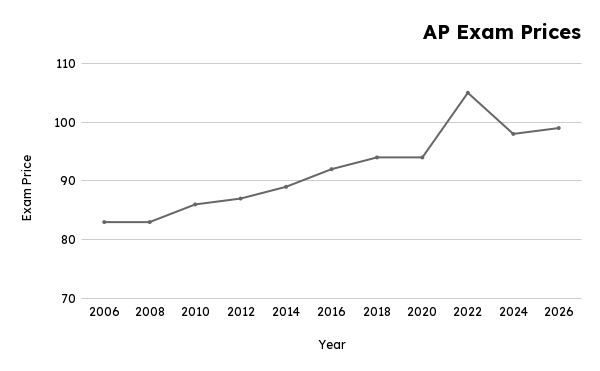
In 2006, a single AP exam cost $83. Throughout the 2010s, the price gradually climbed throughout the $90 range before reaching a whopping $105 in 2022. For the 2026–27 school year, the standard cost is now $99 for a single exam and an additional $40 fee for late applications.
Though the tests aren’t mandatory, nearly $100 for each test can be a devastating expense for the average high school student and their family. For students taking several AP exams, which approximately 47% of test-takers do, the costs can multiply quickly.
The College Board does offer financial assistance. Eligible low-income students can receive a $37 fee reduction, bringing the cost of an exam down to $62, given the test was not ordered late. While the reduction certainly helps, $62 is still a substantial amount of money for a family already struggling financially. A discount of this proportion does not necessarily make an already expensive exam affordable.
The financial risk becomes even more concerning when considering the statistics of AP scores throughout the nation. According to New York Times reporter Dana Goldstein, 1.1 million of the 5.2 million AP exams taken in 2022 were taken by students from low-income families. Around 60% of those students received scores of 1 or 2 out of 5, which are not considered passing and are too low to earn any college credit. To make matters even worse, this pattern has remained relatively consistent for roughly 2 decades.
Meanwhile, the College Board collects nearly $500 million annually from AP tests. About $90 million of that revenue comes from the government, and approximately $37 million of that budget goes towards covering exam fees for low-income students.
This creates a frustrating dilemma. Students from low-income families may have the most to gain from early college credit, since avoiding even one college course can potentially save hundreds to thousands of dollars.
High exam prices may also very likely discourage students from taking the tests altogether. A student who knows that an exorbitant $99 fee could result in no college credit may decide that the financial risk isn’t worthwhile. AP Studio Art teacher Brooke Delello expressed concern for the impacts of such high fees on enrollment. “My fear is that there’s going to be people who will stop taking the class, how that impacts our numbers, whether or not we’ll be able to run the class at that point,” said Delello. “I don’t want AP to be seen as something that’s only available to the upper echelon.”
AP classes themselves can still provide incredibly valuable academic preparation and knowledge, even when a student does not earn college credit. However, that educational benefit does not eliminate the financial burden of the exam itself. The purpose of AP courses is to give students access to college-level education while still in high school, and cost should not undermine that purpose.
AP exam prices absolutely need to be lowered, especially for students with financial need. A more affordable exam would make the program more accessible without removing the academic challenge that makes AP courses valuable. There is no reason for an exam intended to expand students’ educational opportunities to become a burden.