By Starly Richards,
Media Editor.
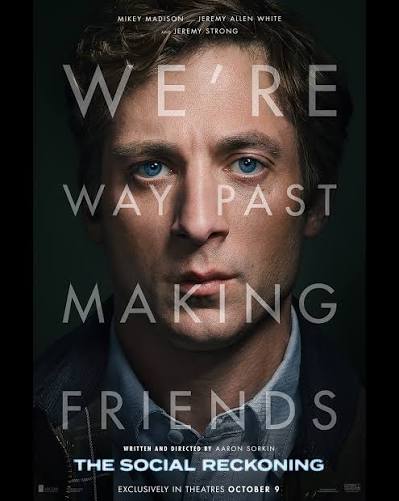
The Social Reckoning released Oct. 9, and after the success of The Social Network, it had a high bar to reach; however, it barely left the floor. The Social Network (predecessor to The Social Reckoning), written by Aaron Sorkin, was a funny and interesting movie that felt more like a dram-edy than a biopic.
The Social Network fan and senior Lena Meline said, “The Social Network has been one of my favorite movies since forever. I love it because it has this electric energy that I have not seen in a lot of movies, especially biopics. The writing is really fast and almost frantic, but I think that makes it feel more human and super engaging.” This is not an opinion held by Meline alone, instead it is revered as almost a truth about the movie. “It did a good job of making what seems like a boring story super fun to watch,” said Meline.
Like the first movie, The Social Reckoning documented lawsuits surrounding Facebook. Unlike the first movie, The Social Reckoning focuses on the events preceding the lawsuit, and not in a cool way. The movie primarily follows two characters and their role in the Facebook Files; Jeff Horwitz, a journalist from The Wall Street Journal seeking to write an exposé on Facebook, and Frances Haugen, a fed-up data-engineer from Facebook’s Civic Integrity team. Occasionally, we get to check in on Mark Zuckerberg as he prepares for the lawsuit.
The entirety of the film was consistent of the journalist and the employee meeting up several times over a couple years as the journalist prodded for information and the employee gave him her complaints about the company and their policies around the management of ragebait, redpilled, engagement-farming content, but not providing enough solid evidence that he would be able to use for a convincing article. “I was at least expecting the social reckoning to be a little good, but it was boring as hell,” said Meline.
The score for the movie was almost non-existent, which made emotional or tense scenes that much harder to sink into. The writing was corny and stiff, which made it difficult to suspend disbelief, even in the non-fictional story. Meline said, “I think the biggest let down for me was the writing. Aaron Sorkin is known for his amazing and unique screen writing, but this movie was slow and monotonous and unnatural to listen to and didn’t feel at all like what I know Aaron Sorkin is capable of doing.” Meline complained that, “it didn’t have any interesting social commentary outside of ‘social media is toxic.” The movie was unimportant, uninteresting and unimpressionable.
At the end of the movie, Zuckerberg is given a choice to either not interfere or silence posts made by Donald Trump during the events of Jan. 6, 2021, which is the most interesting scene of the entire movie and it lasts for about one minute.