By Lillian Gutsch and Russell Wettle,
Managing Editor and Business Editor.
This school year, the state of California – and Santa Rosa High School – has implemented a new cell phone policy. The policy states that during school hours, students’ phones must be off and out-of-sight throughout the day. This doesn’t just mean during class time; this also includes breaks, free periods and lunch. However, at Santa Rosa High School this policy is enforced in an inconsistent, confusing and often bizarre way.
The new policy is based on valid reasoning as we, a younger generation, spend a lot of our time on screens, which has become an issue. We tend to socialize less, do worse on school work and pay less attention to our surroundings or school curriculum when using our phones in school.
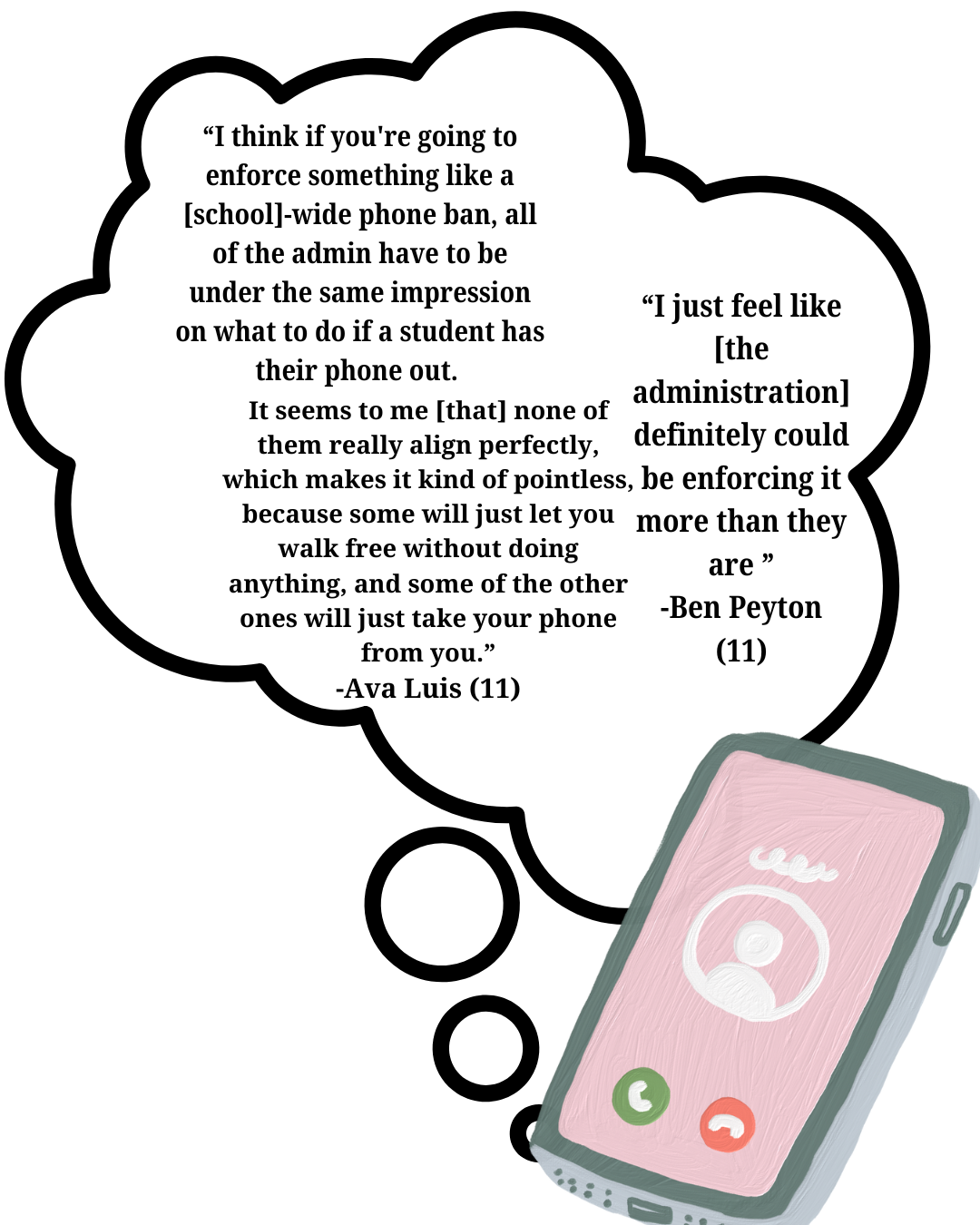
The policy itself is not the problem, but rather the way that it is being enforced. Inside the classroom, in order to enforce the rule most teachers use cellphone caddies or the honor system, which is received fairly well by the students as they keep their phones in their bags (for the most part). However, once students step outside the classroom, the enforcement becomes inconsistent.
Compared to the teachers’ unified stance on policy enforcement, the administrators, such as the principal, vice principals and SSAs have varying positions regarding the issue. Some patrol the campus and take any phones they see, while others give a simple warning to put the phone away, and some staff don’t enforce the policy at all. These irregular responses to the same problem don’t make students feel secure in the way their school is being run. “The goal is not to catch students with their phones or create more discipline. The goal is to reduce distractions during the school day and help students stay focused on learning, their classes and the people around them,” said principal Dr. Kimberly Clissold.
The issue worsens when the administrators don’t seem to be following the same rules they set for the students and use their personal devices such as phones. This comes across to students as completely unfair and hypocritical. “Administrators and staff use our phones throughout the day for school business, including communicating with colleagues, responding to on-campus situations and handling emergencies,” said Dr. Clissold. “At the same time, we need to be aware of how our own phone use appears to students and make sure we are modeling the responsible use we are asking of them.”
Additionally, many methods of enforcement feel unfairly extreme. Before school started, the administration’s stated policy was to issue warnings before confiscation. However, it seems that the administrators have skipped these warnings, going straight to keeping students’ phones until the end of the day, which some students find unfair.
Despite any issues with how it is currently enacted, the administration team is ready to work on improving how SRHS’ phone policy is handled. “I think the biggest thing is that this is about creating a better school environment for students,” said Dr. Clissold. “I appreciate the way most students and staff have worked with us on it, and we will keep listening to feedback and making sure our expectations are clear and consistent.”
The phone policy’s enforcement isn’t perfect, but as long as the administration strives to respond consistently and fairly, the implementation of these new rules shouldn’t be a lasting issue.