By Yazmin Avila Rivas,
and Nico King Gile,
Staff Writers.
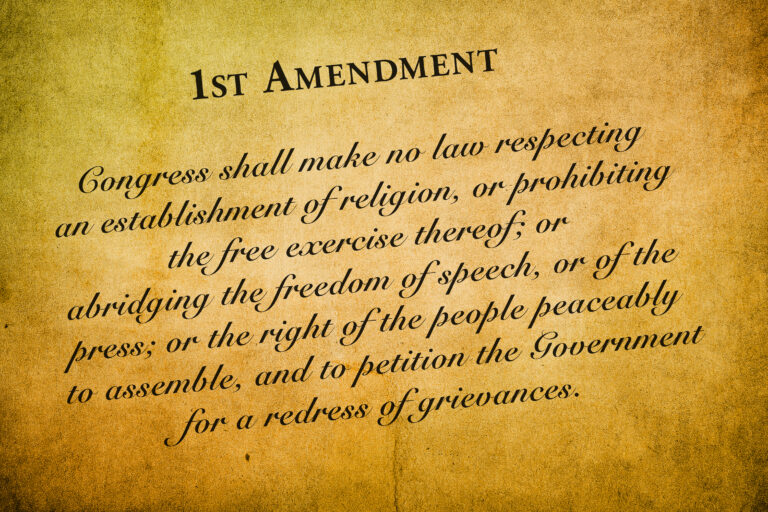
Our Bill of Rights states that “Congress shall make no law. . . abridging the freedom of speech, or of the press.” This deeply ingrained yet constantly contested American belief is once again being questioned.
People are losing their jobs simply for talking about the assassination of Charlie Kirk and anti-Israel protestors are being targeted for deportation while hate speech is spread rampantly on social media platforms. A question is being laid upon us by the very people who argued that there was no question to be asked, people who argue that hate is unacceptable now that is upon them.
In our country’s past, there have been other similar situations where the power of the First Amendment has been called into question. Under the Sedition Act of 1798, citizens were arrested for speaking out against the government, and even at that time, those in power came up with an excuse for this restriction: a war against the French.
The act made it illegal to print “false, scandalous and malicious writing or writings against the government of the United States, of either house of the Congress of the United States, or the President of the United States.” Four people who simply wrote out against the government in protest were silenced and sentenced to jail.
Later during the Vietnam War, Americans’ rights were challenged. The federal government stopped the publishing of the Pentagon papers which revealed America’s long term involvement in Vietnam, with an intjuction. The resulting case—the Pentagon papers’ ruling—protected the press from government pre-publication censorship.
In the Kent State shooting, four peaceful unarmed protesters were shot and killed by the National Guard, a horrific way to shut down the protest and a threat to those protesting at the time. Four days later, on May 8, at New Mexico University 11 peaceful strikers and reporters were charged and stabbed with bayonets by the National Guard, harking back to a seemingly long-past crueler time. This is the history of free speech, press and assembly: a history rife with oppression.
Near the beginning of his second term, President Trump signed a presidential order called “Restoring Freedom of Speech and Ending Federal Censorship,” which states that Trump would stop the government from preventing any citizen’s free speech. In 2023, at a California Republican Convention, Trump used this free speech: “We’ll stand up to crazy Nancy Pelosi, who ruined San Francisco—how’s her husband doing, anybody know?” Pelosi’s husband was beaten with a hammer in their home.
Yet here we are, two months later and his presidency has attempted to silence Jimmy Kimmel, a popular late-night show host, for saying the “MAGA gang” was “desperately trying to characterize this kid who murdered Charlie Kirk as anything other than one of them and doing everything they can to score political points from it.” Brendan Carr, the chairman of the Federal Communications Commission (FCC) of the U.S., threatening to use American telecom laws, persuaded ABC to take Kimmel off the air.
Two months later and the Pentagon has forced all journalists who have press credentials access to the press room to sign a contract that may revoke their press credentials if they release unapproved information—including unclassified documents—that had not been authorized. This contract is similar to the state-controlled media in places often considered un-American such as Russia or North Korea. Journalists are reacting by quitting, with veterans packing their bags, leaving to write with freedom.
Many others have also been victims of censorship this year. Palestinian student activist Mahmoud Khalil was detained on March 8 by Immigration and Customs Enforcement in his home without a warrant.
He was held in a detention center in Louisiana due to Trump’s promise to crack down on “un-American” activity by protesters, which is ironic because protesting is enshrined in our First Amendment. He is among student activists in support of Palestine, which Trump claims are pro-Hamas and pro-terrorist despite his claims to free speech.
Vice President, JD Vance pushed to “call them out, and hell, call their employer.” People have been fired because of this; private and public workers from schools to McDonald’s have lost their jobs. JD Vance recently said, “We believe in free speech in the Trump administration.” Reconciling these two statements seems impossible, as he wants people fired for speaking their mind yet supports their freedom of speech.
The repercussions of these actions are felt by Americans all around the country. Spanish teacher Emma Zavala explained, “It’s getting harder for people to express themselves and be okay with it. Obviously, it’s not okay that the First Amendment is being taken away since this is a country where you’re supposed to have freedom of speech, freedom of press.” Fear itself stifles open and free speech; those who feel afraid of losing their livelihood will not speak out.
Will we, the Americans, who have sued for the independence of the press, who have rioted for the freedom of speech, who have died for the power of assembly, let this wave of change wash our rights away?